
Why Am I Anxious for No Reason? Understanding Anxiety When Nothing Seems Wrong
Have you ever felt anxious even though you could not point to anything specific that was wrong?
Maybe your chest feels tight, your thoughts are racing, or you have a sense that something bad is about to happen. You try to figure out what you are worried about, but nothing obvious comes to mind.
It can be confusing to feel anxious when life seems relatively okay. You might even start questioning whether you have a “good enough” reason to feel the way you do.
But anxiety does not always have an obvious cause. Sometimes there may be stressors you have not fully noticed yet. Other times, you may recognize the feeling of anxiety before you understand what is contributing to it.

“Feeling anxious without knowing why does not mean there is no reason. Sometimes what is contributing to anxiety is simply harder to recognize.”
Why do I feel anxious for no reason?
When anxiety seems to come out of nowhere, it does not necessarily mean there is no reason for it.
You may have been dealing with ongoing stress, uncertainty, changes in your life, relationship difficulties, pressure at work, family expectations, or simply too many things demanding your attention at once.
None of those things necessarily need to feel overwhelming on their own.
Stress can build gradually.
You might still be going to work, seeing friends, getting things done, and carrying on with your routine while feeling increasingly tense, irritable, restless, or mentally exhausted.
Sometimes it is only when anxiety becomes more noticeable that you realize how much you have been carrying.
Can anxiety happen when nothing is wrong?
Yes. Anxiety is a normal human response and does not only occur when something dangerous is happening in the present moment.
You might notice:
Feeling on edge even when your day is going well
A racing heart or tightness in your chest
Difficulty relaxing
Restlessness
Trouble concentrating
Irritability
Feeling like you are waiting for something to go wrong
Frequently checking how you feel to see whether the anxiety has gone away
Anxiety can affect both the way we think and the way we feel physically. Common physical experiences can include a pounding heart, shortness of breath, sweating, nausea, dizziness, and chest tightness.
The frustrating part is that not knowing why you feel anxious can become another thing to worry about.
You start searching for an explanation.
What am I worried about?
Did something happen?
Why can't I just relax?
What if this feeling doesn't go away?
Before long, you may find yourself worrying about the anxiety itself.
Why does my body feel anxious when my mind doesn't?
Anxiety is not just something that happens in your thoughts. It can also show up physically.
You may notice your heart beating faster, your muscles feeling tense, changes in your breathing, sweating, nausea, or simply a general feeling that something is “off.”
This is one reason telling yourself there is nothing to be anxious about does not always make the feeling disappear.
You can logically recognize that nothing is obviously wrong while still noticing very real feelings of anxiety.
And sometimes, instead of immediately trying to make those feelings disappear, it can be useful to become curious about what has been happening lately.
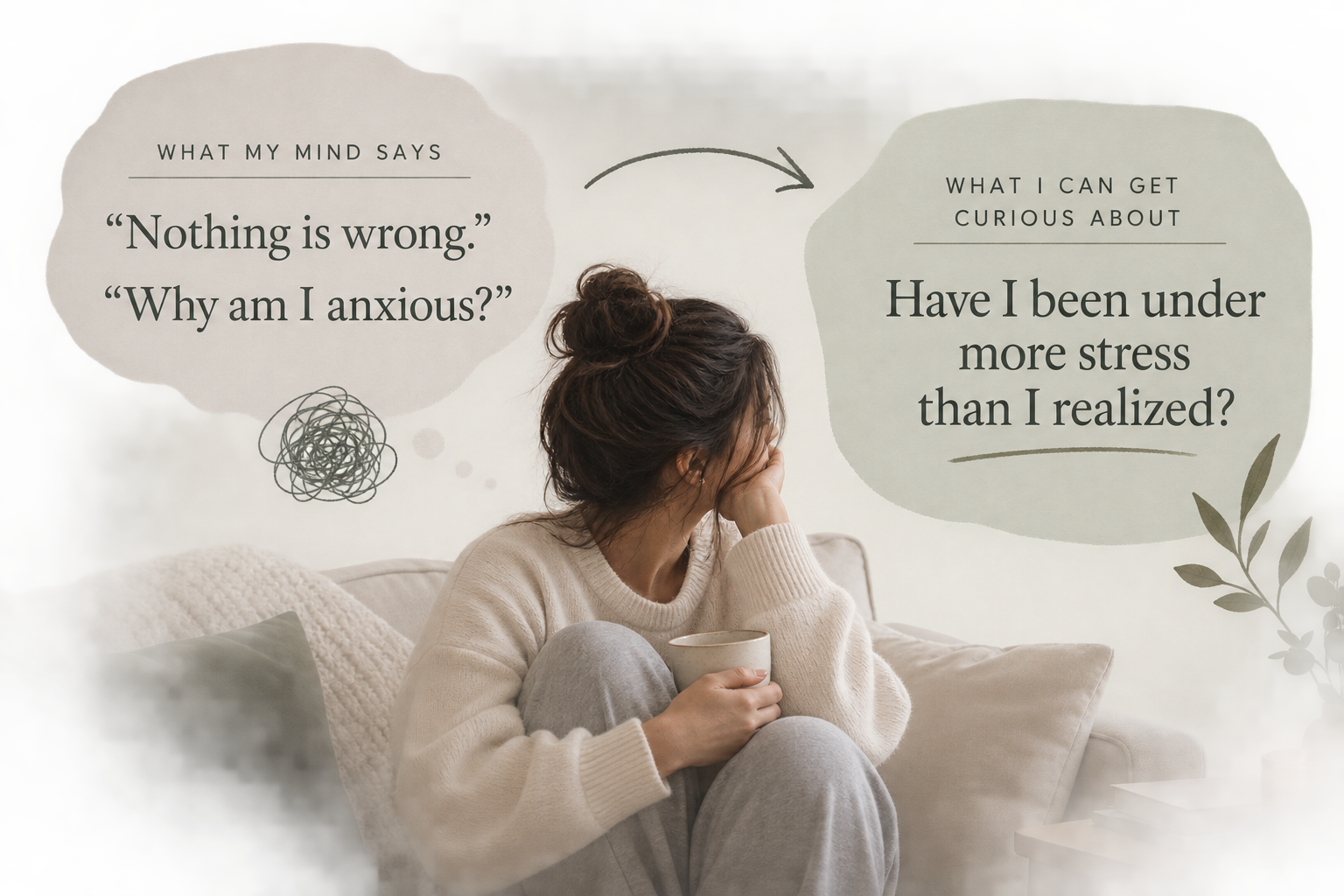
Can stress build up without me realizing it?
It can.
We tend to notice stress most when something big happens. But stress can also come from smaller pressures that continue over time. CAMH notes that stress can show up cognitively, emotionally, physically and behaviourally, including through constant worrying, difficulty concentrating, irritability, anxiety, difficulty relaxing and muscle tension.
Maybe work has been unusually demanding. You have not been sleeping well. There is tension in one of your relationships. You have been worrying about money. Your schedule has been packed. You are going through a transition. Or you have simply had very little time to slow down.
You may adapt to each thing as it happens.
Eventually, being stressed can start to feel normal.
That does not mean it is not affecting you.
Why is my anxiety worse when I finally relax?
This can feel especially confusing.
You get through a busy day relatively fine, but the moment you sit down at night, your mind suddenly becomes loud.
Or you finally have a weekend with nothing planned and somehow notice yourself feeling more anxious instead of less.
One possible explanation is simply that when you are busy, your attention has somewhere else to go. There are tasks to complete, conversations to have, places to be, and problems to solve.
When things become quiet, there may be more room to notice thoughts or physical sensations that did not have your attention earlier.
That does not necessarily mean relaxing is causing your anxiety.
What can I do when I feel anxious for no reason?
Your first instinct may be to figure out exactly why you feel anxious.
Sometimes that is helpful. If there is a problem that needs your attention, understanding it can help you decide what to do next.
But you do not always need a perfect explanation before you can respond to what you are feeling.
You might start by asking yourself:
What am I noticing in my body right now?
Have I been under more pressure lately?
Have I been sleeping and eating regularly?
Is there something I have been avoiding or carrying emotionally?
What would help me feel a little more grounded right now?
That might mean going for a walk, slowing down your breathing, stepping away from your phone, talking to someone you trust, eating something if you have not eaten, resting, or allowing the feeling to be there without immediately trying to solve it.
You can also remind yourself:
I feel anxious right now. I do not need to understand everything about this feeling immediately.
The goal is not necessarily to force yourself to stop feeling anxious. Sometimes it is about learning how to respond differently when anxiety shows up.
When might therapy help with anxiety?
Feeling anxious sometimes is a normal part of being human.
But if anxiety is happening frequently, causing significant distress, affecting your sleep, making it difficult to concentrate, interfering with your relationships, or getting in the way of everyday life, it may be worth seeking additional support.
Therapy can give you space to better understand what may be contributing to your anxiety, notice patterns in how you respond to it, and develop different ways of coping when it shows up.
Anxiety can also involve a lot of worrying, analyzing, and trying to find certainty. If that sounds familiar, you may also find [Why Do I Overthink Everything? Understanding Overthinking and Anxiety] helpful.
At Brighter Ways Therapy, I work with individuals across Ontario experiencing anxiety, overthinking, stress, relationship concerns, self esteem, and life transitions.
Sessions are offered online. If you are curious about whether therapy might be helpful for you, I offer a free 15-minute consultation to see whether we may be a good fit.
