
Why Am I So Hard on Myself? Understanding Your Inner Critic
Have you ever made a small mistake and found yourself thinking about it for hours?
Maybe you said something awkward, forgot to do something, did not perform as well as you hoped, or received criticism from someone. Even when other people seem to move on, you keep thinking about what you should have done differently.
You might tell yourself you should have known better. You should have tried harder. You should be further ahead by now.
And sometimes, even when you accomplish something, your mind quickly finds the next thing that could have been better.
If this sounds familiar, you may have a strong inner critic.
Being hard on yourself can feel like a way of holding yourself accountable or pushing yourself to do better. But when self criticism becomes constant, it can make mistakes feel threatening, accomplishments feel insignificant, and your own expectations almost impossible to meet.

“There is a difference between recognizing something you want to change and using it as evidence that something is wrong with you.”
What is an inner critic?
Your inner critic is that critical voice in your thoughts that evaluates what you do, how you look, how other people perceive you, or whether you are “good enough.”
It might sound like:
Why did I say that?
I should be doing better than this.
Everyone else seems to have it together.
I always mess things up.
I should have known better.
I am not doing enough.
Having critical thoughts about yourself sometimes is normal. We all evaluate our behaviour and recognize things we would like to change.
The difference is that a harsh inner critic often goes beyond evaluating what you did and starts making conclusions about who you are.
A mistake becomes I am a failure.
Not knowing something becomes I am stupid.
Someone being disappointed in you becomes I am a bad person.
That distinction matters.
Why am I so hard on myself?
There are many reasons why you might be hard on yourself.
For some people, high expectations have been part of their lives for a long time. You may have learned that doing well brought praise, approval, or a sense of security.
For others, mistakes may have been met with criticism, comparison, disappointment, or consequences that made getting things “right” feel especially important.
Your experiences with family, school, relationships, culture, work, and even your own temperament can influence the standards you develop for yourself.
Sometimes self criticism also develops as an attempt to protect you.
If you criticize yourself first, maybe someone else's criticism will hurt less.
If you think through everything you did wrong, maybe you can prevent yourself from making the same mistake again.
If you constantly push yourself, maybe you will never become lazy or fall behind.
The inner critic can therefore feel useful, even when the way it speaks to you is painful.
Does being hard on myself actually motivate me?
You might worry that if you stop being hard on yourself, you will become complacent.
If I let myself off the hook, won't I just keep making the same mistakes?
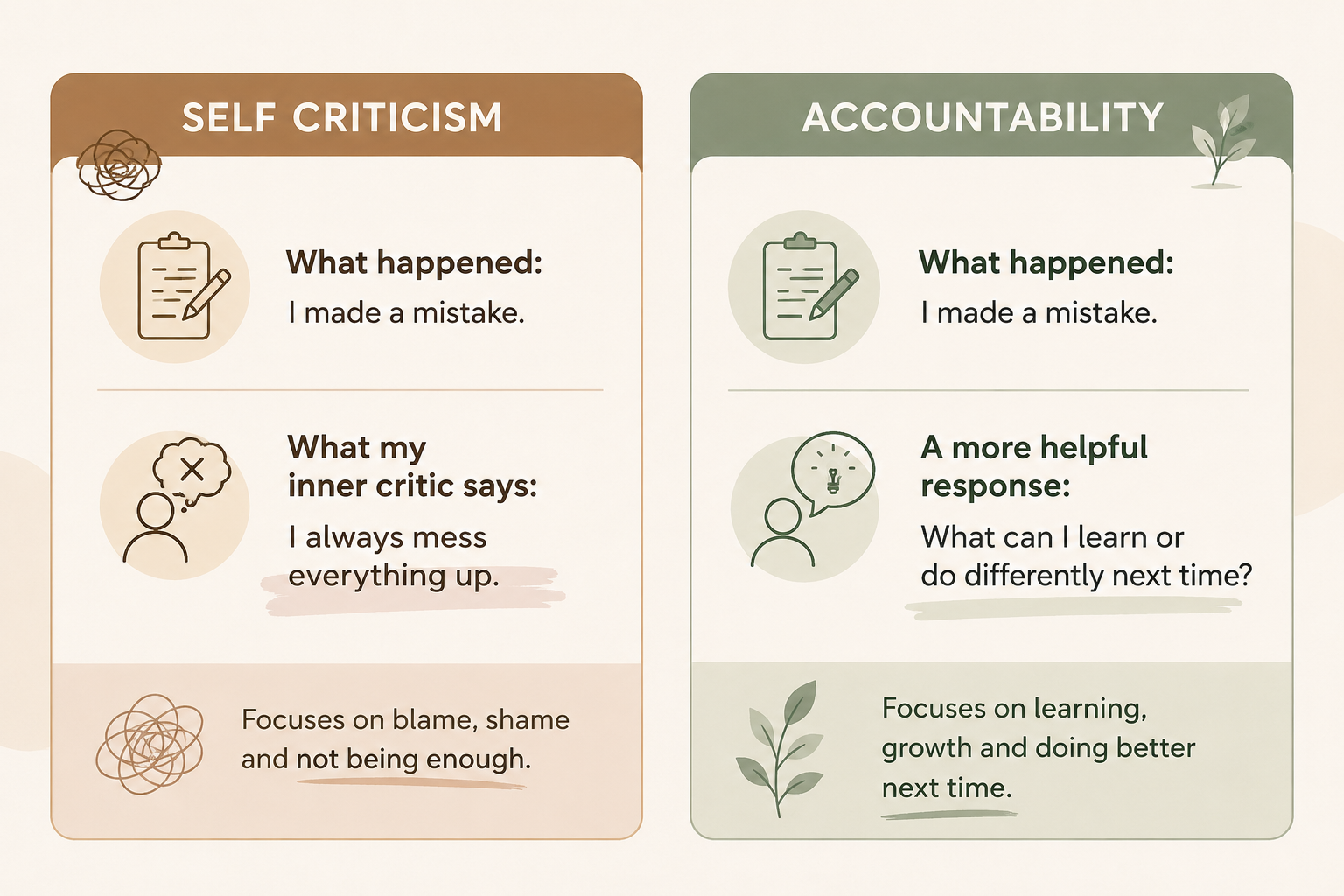
But accountability and self criticism are not the same thing.
You can recognize that you handled something poorly without deciding that you are a terrible person.
You can want to improve your performance without telling yourself you are incompetent.
You can regret something you said without replaying it for the next three days.
Being compassionate toward yourself does not require pretending everything you do is okay.
It changes how you respond to yourself when something isn't.
Why do I dismiss my accomplishments?
A harsh inner critic does not only show up when something goes wrong.
Sometimes it changes the way you respond when things go well too.
You accomplish something you worked hard for and immediately think:
It wasn't that difficult.
Anyone could have done that.
I just got lucky.
I still could have done better.
Or you briefly feel proud before comparing yourself to someone who seems further ahead.
When your attention is constantly drawn toward what needs improvement, accomplishments can start to feel like the minimum expectation rather than something worth recognizing.
The goal is not to convince yourself that everything you do is extraordinary. It is simply to allow positive information about yourself to count too.
Why do I talk to myself in ways I would never talk to someone else?
It is often much easier to give other people grace than it is to give ourselves the same treatment.
When a friend makes a mistake, it can be easier to see the bigger picture. You might understand why it happened, remind them that one mistake does not define them, or help them think about what they could do differently next time.
But when you are the one who made the mistake, that perspective can disappear pretty quickly.
You might think, I should have known better or I can't believe I did that.
And if someone tells you to “talk to yourself like you would talk to a friend,” part of you might resist that too. Maybe you think your situation is different, or that being understanding with yourself means making excuses.
You do not have to suddenly become incredibly compassionate toward yourself. Sometimes a more realistic place to start is simply being fair.
If you handled a conversation poorly, you can acknowledge that. But I handled that conversation poorly is very different from I ruin every relationship I have.
One describes something you did and gives you room to learn from it. The other turns one difficult moment into a statement about who you are.
How can I stop being so hard on myself?
You probably are not going to stop having critical thoughts altogether. A more realistic goal is to notice when reflection turns into attacking yourself. When that happens, it may be helpful to ask:
What actually happened?
What am I making this mean about me?
Would I apply this same standard to someone else?
Is there something I genuinely need to take responsibility for?
What would a fair response to myself sound like?
Sometimes a fair response might be:
I wish I had handled that differently.
I made a mistake and I can repair it.
I am disappointed, but this does not define me.
I can learn from this without punishing myself.
You do not have to completely believe these statements right away.
If you are used to motivating yourself through criticism, responding differently may initially feel unnatural at first.
The goal is not to never hold yourself accountable. It is learning that accountability does not require cruelty.
When can therapy help with self criticism?
If you constantly feel like you are not doing enough, struggle to feel proud of yourself, spend a lot of time replaying your mistakes, or feel like your worth depends on how well you perform, therapy can be a place to explore those patterns more closely.
Therapy can give you space to understand where some of these expectations came from, recognize when your inner critic tends to show up, and find ways ot responding to yourself that do not rely so heavily on criticism.
If self criticism also leads you to repeatedly analyze your mistakes or conversations, you may find Why Do I Overthink Everything? Understanding Overthinking and Anxiety helpful as well.
At Brighter Ways Therapy, I work with individuals across Ontario experiencing self esteem concerns, anxiety, overthinking, stress, relationship concerns, and life transitions.
Sessions are offered online. If you are curious about whether therapy might be helpful for you, I offer a free 15-minute consultation to see whether we may be a good fit.
