
Why Do I Feel Responsible for Everyone Else’s Feelings?
Someone around you seems upset.
They haven't said you're the reason. They may not have said anything at all.
But you notice.
Their tone is different. They're quieter than usual. Something feels off.
And almost immediately, your mind starts working.
Did I do something?
Should I ask what's wrong?
How do I make this better?
Maybe you check in with them. If they tell you they're fine but still seem unhappy, you keep wondering about it. If they tell you they are upset, you start thinking about what you can say or do to make them feel better.
Being aware of other people's feelings isn't a bad thing. Caring about the people around you is an important part of relationships.
But caring about someone's feelings and feeling responsible for changing them are two very different things.

“Sometimes the question isn’t “Am I doing enough?” It’s “What have I learned I need to do before I’m allowed to feel good about myself?””
Why do I feel responsible for other people's feelings?
There are many ways you can become used to paying close attention to how other people feel.
Maybe conflict makes you uncomfortable, so you've learned that keeping everyone happy makes relationships feel easier.
Maybe being helpful, agreeable, or easygoing has become an important part of how you see yourself.
You may have spent time around people whose reactions were difficult to predict, or learned through previous relationships that someone being upset could quickly become your problem.
Family and cultural expectations can matter too. Caring for other people, maintaining harmony, and considering how your choices affect those around you can be deeply important values.
The difficulty isn't caring about others.
It's when their emotional state starts determining whether you feel okay.
Someone being disappointed with you may feel unbearable. A change in someone's mood can make it difficult to focus on anything else. You may feel like you can't relax until you know everything between you is okay again.
Why do I assume people are upset with me?
Sometimes you don't even need someone to tell you they're upset.
You notice the smallest change.
A shorter text.
A different tone.
Someone who usually talks a lot suddenly becoming quiet.
And your mind fills in the missing information.
They're upset with me.
That interpretation might be right. But there are also dozens of reasons someone could seem different that have nothing to do with you.
They could be tired. Distracted. Worried about something. Having a bad day. Thinking about a conversation you know nothing about.
The challenge is that when you already feel responsible for other people's emotions, “Did I do something?” can become your default explanation.
You can check in when it makes sense. What you don't have to do is immediately assume responsibility for a feeling you don't yet understand.
Why do I always try to fix things when someone is upset?
Knowing someone you care about is struggling can create a strong urge to do something.
You give advice.
You offer solutions.
You apologize.
You change your plans.
You try to cheer them up.
Sometimes that's exactly what the situation calls for.
But other times, the urge to fix someone's feelings is partly about how uncomfortable you feel knowing they're upset.
Imagine your partner is disappointed because you've decided to spend an evening with friends instead of staying home.
You care that they're disappointed.
Then the guilt starts.
Maybe you offer to cancel. Maybe you promise you'll come home early. Maybe you spend the entire evening checking your phone to make sure they're okay.
At some point, you may no longer be responding to what your partner actually needs. You may be trying to get rid of the discomfort you feel because they're unhappy with your decision.
Someone can be disappointed and you can still go.
Both things can be true at once.
Am I responsible for other people's emotions?
You have responsibility for how you treat people.
If you say something hurtful, break an agreement, lie, behave disrespectfully, or make a mistake that affects someone else, their feelings matter. Taking responsibility might mean listening, apologizing, repairing something, or changing your behaviour.
But being responsible for your behaviour isn't the same as being responsible for every emotion another person experiences.
Sometimes people will be disappointed by reasonable decisions you make.
Someone may be sad that you can't attend an event.
A friend might feel hurt that you don't have the capacity to talk tonight.
A family member may dislike a choice you're making with your own life.
Their feelings can be real without automatically meaning your decision was wrong.
This is where it can help to ask a more specific question than Are they upset?
Ask:
Did I actually do something I need to take responsibility for?
If the answer is yes, you can respond to that.
If the answer is no, the task may be allowing another person to have a feeling you wish they weren't having.
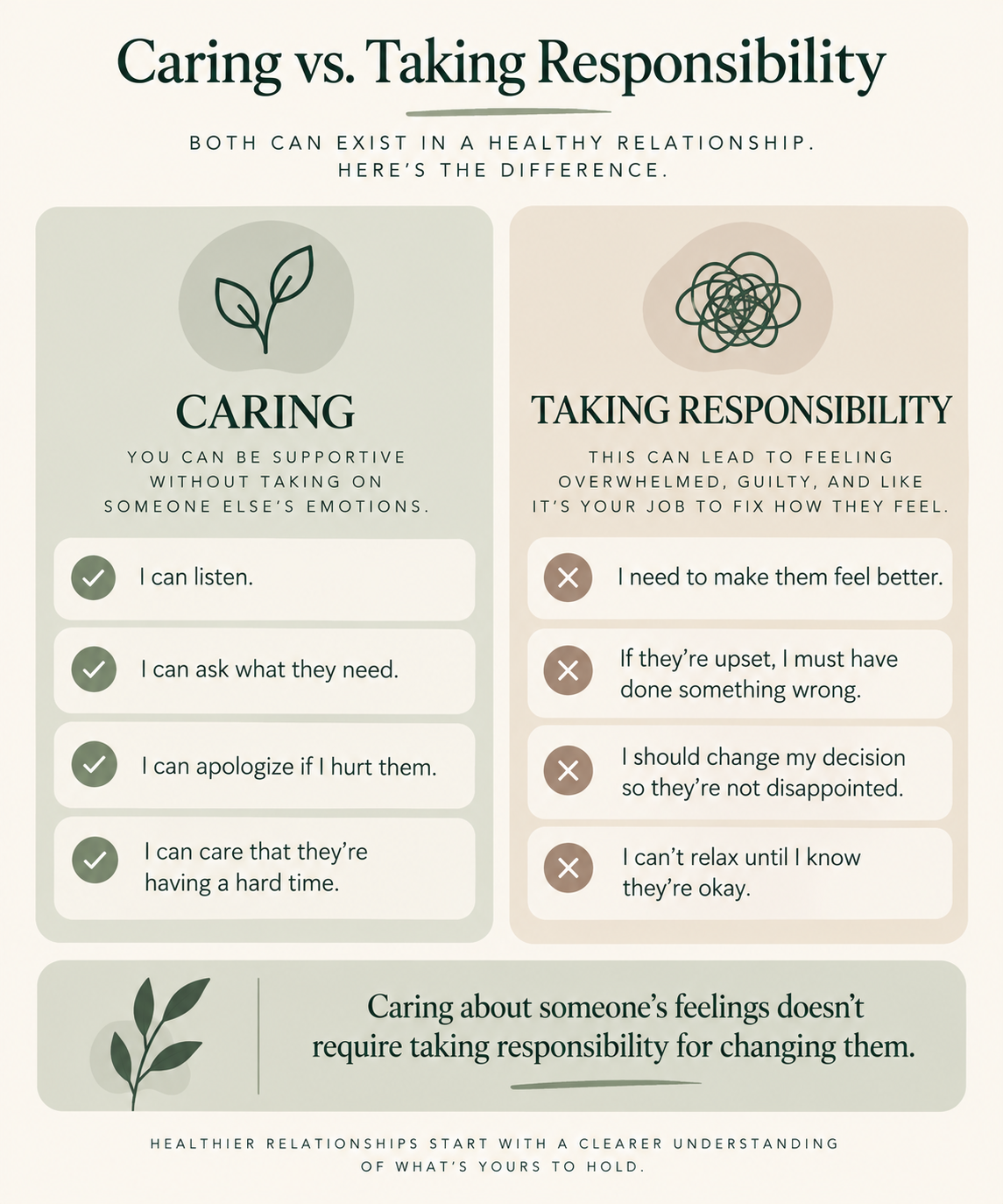
What's the difference between caring and taking responsibility?
You don't need to become detached from other people's feelings.
You can still notice when someone seems off.
You can ask how they're doing.
You can listen when someone is struggling.
You can offer support.
And you can apologize when you've hurt someone.
The difference is what happens next.
Caring might sound like:
“I can see that you're disappointed.”
Taking responsibility might sound like:
“You're disappointed, so I need to change my decision.”
Caring leaves room for both people to have feelings and needs.
Taking responsibility can leave you feeling as though you need to manage the emotional atmosphere around you before you're allowed to feel okay yourself.
How do I stop feeling responsible for everyone's feelings?
You probably won't stop noticing other people's emotions.
And if you're naturally attentive to the people around you, you may not even want to.
Instead, start noticing what happens after you notice.
Someone seems upset.
What does your mind immediately tell you to do?
Do you assume you caused it?
Do you start explaining yourself?
Do you abandon a decision you were comfortable with five minutes earlier?
Do you feel pressure to make them feel better?
Before reacting, try separating three things:
What do I know?
They're quieter than usual.
What am I assuming?
They're upset with me.
What is actually mine to do?
I can check in, but I don't need to decide what they're feeling before they tell me.
And when someone really is upset with you, the question changes slightly.
Instead of:
How do I make them stop being upset?
Try:
Is there something here I need to take responsibility for?
Sometimes there will be.
Sometimes there won't.
Learning to tolerate that difference can make relationships feel much less like a constant emotional problem you have to solve.
Can therapy help if I feel responsible for everyone?
If you spend a lot of energy monitoring other people's moods, preventing disappointment, avoiding conflict, or trying to make sure everyone around you is okay, therapy can help you understand what keeps that pattern going.
You might explore what happens when someone is unhappy with you, what you believe their reaction says about you, and how much room you give yourself to have needs that don't perfectly align with someone else's.
Therapy can also help you become clearer about what you're genuinely responsible for in a relationship and what belongs to the other person.
If guilt tends to show up when you say no or make decisions that someone else doesn't like, you may also find Why Do I Feel Guilty Setting Boundaries? helpful.
At Brighter Ways Therapy, I work with adults across Ontario experiencing anxiety, relationship concerns, self-esteem concerns, overthinking, stress, and life transitions.
Sessions are offered online. If you are curious about whether therapy might be helpful for you, I offer a free 15-minute consultation to see whether we may be a good fit.
