
Why Do I Feel Guilty Setting Boundaries?
Maybe someone asks you for something you genuinely don't have the time or energy to do.
You know you want to say no.
You might even know that saying no is completely reasonable.
But as soon as you do, the guilt starts.
Was I too harsh?
What if they're upset with me?
Maybe I should just do it.
Sometimes you end up explaining yourself more than you wanted to. Other times, you change your mind and agree to something you didn't want to do in the first place.
And even when you stick with your boundary, you may spend the next few hours wondering whether you've done something wrong.
If this sounds familiar, the confusing part is often that you know you're allowed to have boundaries. You may have heard plenty about their importance. Actually setting one and tolerating how it feels afterward can be much harder.

“Feeling guilty after setting a boundary doesn’t automatically mean the boundary was unfair. ”
Why do I feel guilty setting boundaries?
Guilt often makes us think we've done something wrong.
Sometimes that's useful. If you hurt someone or act in a way that goes against your values, feeling guilty can prompt you to take responsibility or repair what happened.
But feeling guilty doesn't always mean you've done something harmful.
You can also feel guilty because you disappointed someone.
Maybe you're used to being available when people need you. Maybe saying yes has helped you avoid conflict or maintain closeness in your relationships. Perhaps other people's approval matters a lot to you, or you're simply very aware of how your decisions affect the people around you.
When you start behaving differently, it can feel wrong before you've actually decided whether it is wrong.
That distinction matters.
Why is saying no so uncomfortable?
A simple no can carry a surprising amount of meaning.
You may worry that saying no makes you selfish, difficult, unreliable, or uncaring.
Maybe you're afraid the other person will be disappointed.
Or perhaps you're worried about what happens after the no.
Will they be annoyed?
Will things become awkward?
Will they think differently of you?
Will you have to explain yourself?
If saying yes usually prevents those possibilities, agreeing can feel easier in the moment.
Imagine a friend asks you to help them move on the only free Saturday you've had in weeks.
You don't want to go. You're exhausted and had planned to spend the day resting.
But then you think:
They've helped me before.
They're going to be disappointed.
I don't really have anything important planned anyway.
Suddenly, resting doesn't seem like a good enough reason to say no.
The decision stops being about whether you want or are able to help and becomes about whether you can tolerate disappointing someone.
Why do I feel responsible when someone is upset with my boundary?
One of the hardest parts of setting boundaries is that sometimes the other person really will be disappointed.
They might wish you'd said yes.
They may disagree with your decision.
They might even tell you they're upset.
Setting a boundary doesn't guarantee that everyone involved will feel good about it.
This is where guilt can become especially powerful. If you're very sensitive to other people's reactions, their disappointment may immediately create an urge to fix the situation.
You might explain yourself repeatedly, soften the boundary, offer something else, or take it back entirely.
Before doing that, it can help to ask:
Did I actually treat this person unfairly, or are they having a feeling about a decision I'm allowed to make?
Those aren't the same thing.
You can care that someone is disappointed without automatically becoming responsible for removing their disappointment.
Does feeling guilty mean my boundary is wrong?
Not necessarily.
But that doesn't mean every boundary is automatically reasonable either.
Instead of using guilt alone to decide, look at what actually happened.
Were you respectful?
Is the boundary something you can realistically follow through on?
Are you protecting your time, energy, privacy, emotional well-being, or another legitimate need?
Are you expecting the other person to make a decision for themselves, or are you trying to dictate what they're allowed to do?
This gives you more useful information than simply asking whether you feel bad.
You might decide that you communicated something too harshly and want to repair that.
You might realize you misunderstood the situation.
Or you might look at what happened and decide:
I don't like that they're disappointed, but I still think saying no was the right decision for me.
Both accountability and boundaries can exist at the same time.
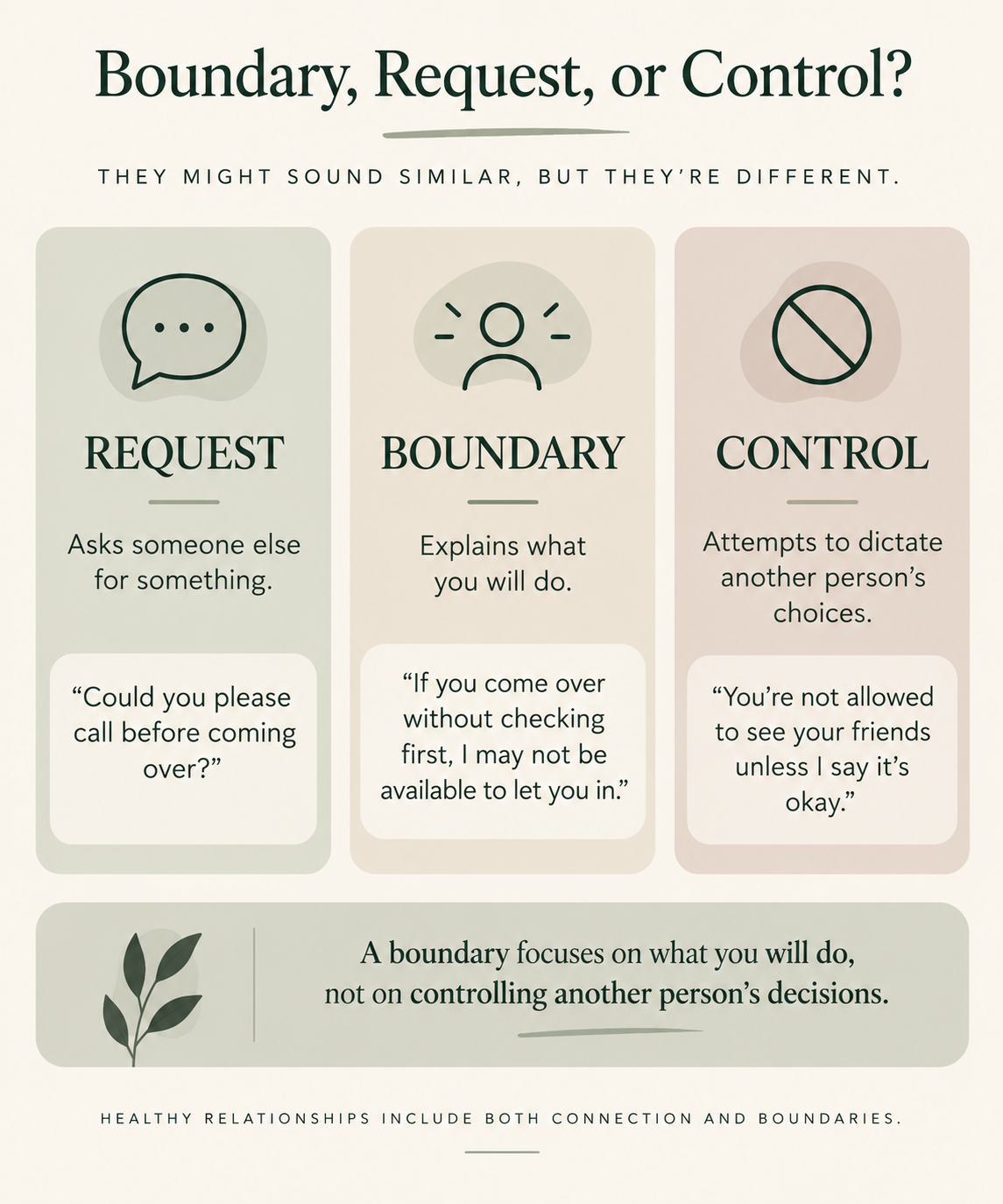
What's the difference between a boundary, a request, and control?
The word boundary gets used very broadly, especially online.
But not every preference or demand is a boundary.
A request asks another person to do something.
“Could you please call before coming over?”
A boundary describes what you will do or participate in.
“If you come over without checking first, I may not be available to let you in.”
Control focuses on making another person's choices for them.
“You're not allowed to visit anyone unless I approve it first.”
Of course, real relationships are usually more complicated than three tidy examples.
But the distinction can be useful when you're wondering whether you're advocating for something you need or trying to manage another person's behaviour.
How can I set boundaries without feeling so guilty?
You may not be able to wait until saying no feels completely comfortable.
If you've spent years avoiding disappointment or prioritizing other people's needs, you might still feel guilty even when you're making a reasonable choice.
Start by separating the feeling from the decision.
I feel guilty.
Then:
What do I believe I did wrong?
Be specific.
Maybe the answer is:
Nothing. I just know they're disappointed.
Or perhaps you realize there actually is something you want to address.
You can also notice whether guilt makes you overexplain.
Sometimes a boundary becomes a five-minute speech because you're trying to find an explanation convincing enough that the other person won't be upset.
You don't always need one.
“I can't make it this weekend.”
“I don't have the capacity to take that on.”
“I'd rather not talk about that.”
These statements may still feel uncomfortable.
The discomfort doesn't have to disappear before you're allowed to follow through.
What if someone keeps pushing my boundaries?
Saying something once doesn't guarantee another person will respect it.
Some people may ask again, argue with your reasoning, try to negotiate, or behave as though your answer is the beginning of a debate.
You don't necessarily need a better explanation.
Sometimes you need consistency.
If you've already answered, you can repeat yourself without producing new reasons every time.
And if someone repeatedly ignores a boundary, you may need to decide what you will do when that happens.
That's an important part of boundaries that can get lost. You cannot always make another person respect your wishes.
You can decide how you respond when they don't.
Can therapy help with boundary guilt?
If setting boundaries regularly leaves you feeling selfish, anxious, or responsible for other people's reactions, therapy can give you space to understand why those situations feel so difficult.
You might look at what you've learned about saying no, conflict, responsibility, approval, and what it means to be a “good” partner, friend, family member, or colleague.
Therapy can also help you distinguish between guilt that points toward something you genuinely want to repair and guilt that appears because you're doing something unfamiliar.
You don't have to stop caring about other people's feelings in order to have boundaries. You can care about someone and still make a decision they don't like.
If you notice that saying no is particularly difficult because you feel responsible for keeping other people happy, I'll be covering that more specifically in Why Do I Feel Responsible for Everyone Else's Feelings?
At Brighter Ways Therapy, I work with adults across Ontario experiencing anxiety, relationship concerns, self-esteem concerns, overthinking, stress, and life transitions.
Sessions are offered online. If you are curious about whether therapy might be helpful for you, I offer a free 15-minute consultation to see whether we may be a good fit.
