
How Do I Know If I’m Burned Out or Just Tired?
You finish a long week feeling completely drained.
So you tell yourself you just need a weekend to recover. You sleep in. You cancel a plan. Maybe you spend Sunday doing very little.
Then Monday comes around and somehow you still feel exhausted.
At that point, you might start wondering: Am I burned out or am I just tired?
It isn't always easy to tell. Being tired is a normal part of being human, especially during busy or stressful periods. Burnout, on the other hand, tends to involve a deeper and more persistent sense of depletion that doesn't disappear after one good night's sleep.
The difference often becomes clearer when you look not only at how tired you feel, but at what is draining you, how long it's been happening, and whether you're actually recovering when you get the chance.

What’s the Difference Between Being Tired and Burned Out?
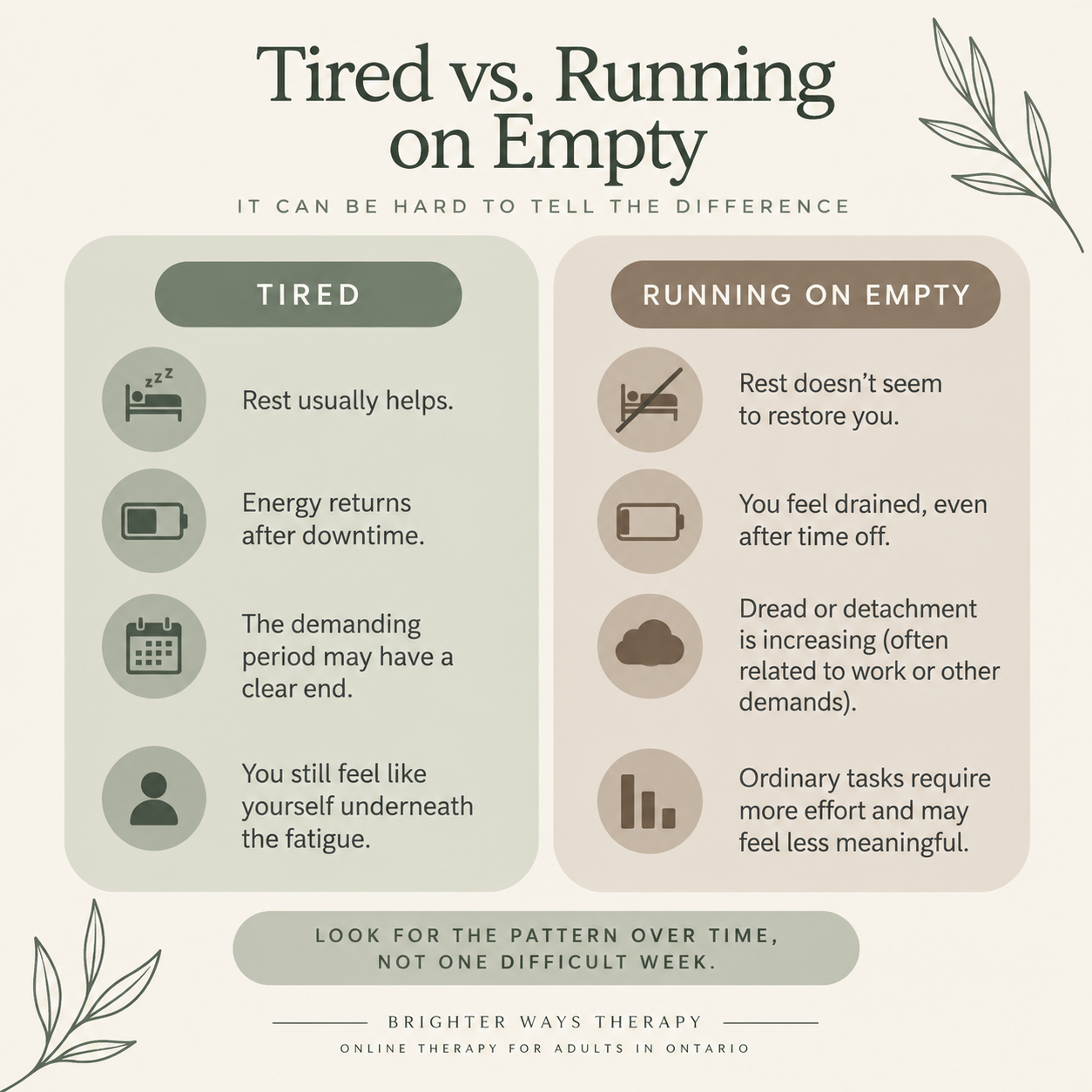
Ordinary tiredness usually has an identifiable reason.
Maybe you stayed up too late. Work has been unusually busy. You've been travelling. Your social calendar has been packed. Your toddler has decided that 5:17 a.m. is an excellent time to begin the day.
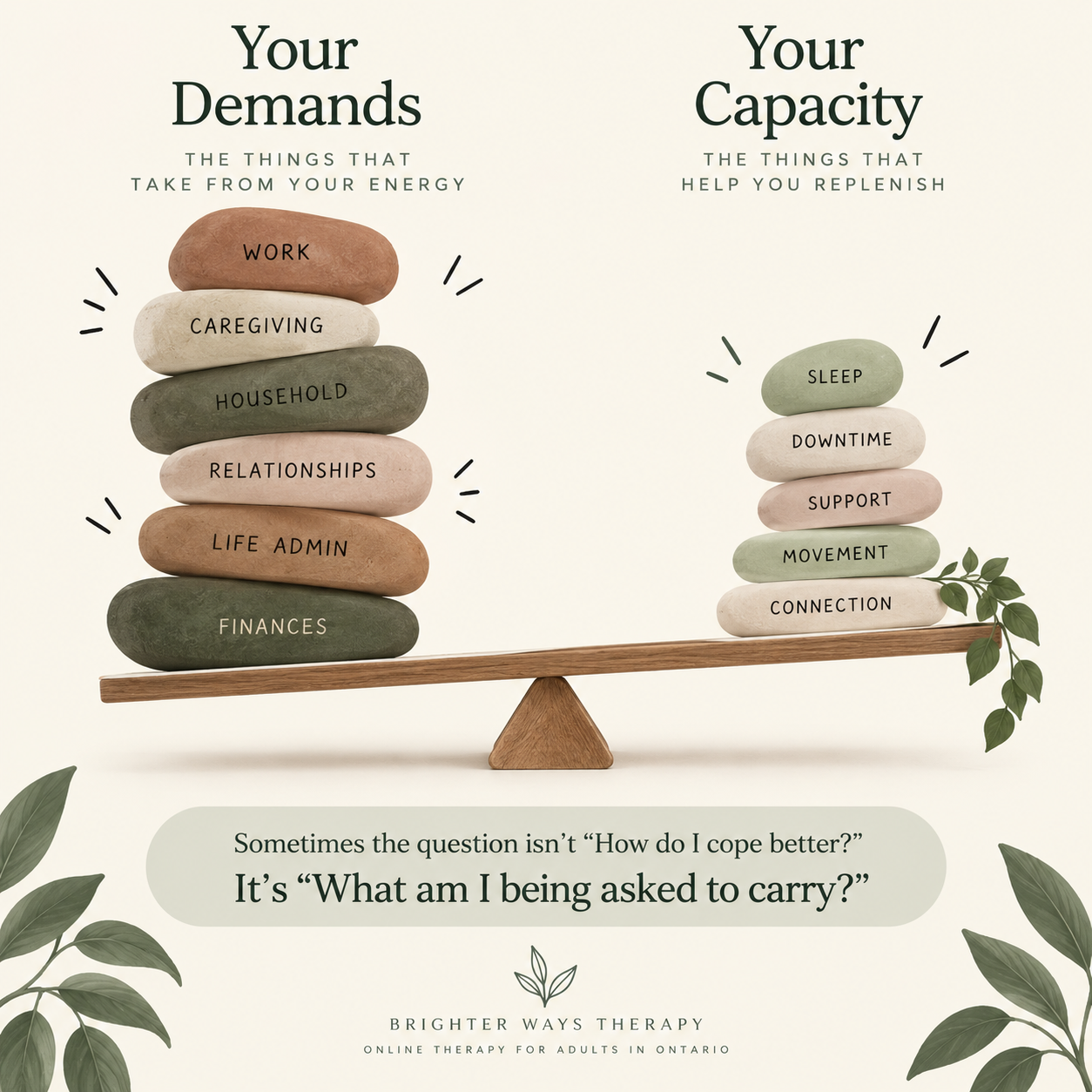
You're tired because your current demands have temporarily exceeded your available energy.
And when you get enough recovery, you generally start feeling more like yourself again.
Burnout can feel different.
You may rest without feeling particularly restored. Things that used to feel manageable start requiring much more effort. You might notice yourself becoming increasingly irritable, detached, cynical, or emotionally checked out.
Instead of thinking, I'm tired today, it starts feeling more like:
I don't know how much longer I can keep doing this.
The World Health Organization describes burnout specifically as an occupational phenomenon associated with chronic workplace stress that hasn't been successfully managed. It includes exhaustion, increased mental distance or negativity toward one's job, and reduced professional effectiveness.
In everyday conversation, people often use "burnout" more broadly to describe prolonged depletion from caregiving, school, parenting, relationships, or simply carrying too much for too long. Whatever word you use, persistent exhaustion is worth paying attention to.
Does Rest Actually Help?
One useful question is surprisingly simple:
What happens when you rest?
Imagine two people finishing an exhausting month at work.
Both take a long weekend.
One sleeps more, sees friends, spends a day doing absolutely nothing productive, and returns to work thinking, Okay. I needed that.
The other does essentially the same thing but spends Sunday evening already dreading Monday. They wake up Monday feeling as though the weekend barely happened.
The amount of rest isn't the only difference. Their ability to recover is different.
Temporary fatigue often improves when the demand decreases.
More persistent depletion may not.
Of course, one weekend isn't a diagnostic test for burnout. You can have an awful Monday after a perfectly relaxing weekend and still be okay. The more useful thing to notice is the pattern over time.
Are you regularly getting opportunities to recover?
And when you do, are they helping?
Burnout Can Show Up as More Than Exhaustion
When people picture burnout, they often imagine someone who can barely get out of bed.
Sometimes it looks much less dramatic.
You might still be going to work every day. You answer your emails. You meet deadlines. Other people may even think you're doing well.
Meanwhile, you've noticed that everything feels harder.
You have less patience with coworkers or clients. Sunday evenings have started feeling heavy. You're doing what needs to be done but don't feel particularly connected to any of it. Small requests annoy you because they feel like one more thing being added to an already overflowing mental list.
You might find yourself fantasizing about quitting your job, moving somewhere nobody knows you, and opening a tiny bookstore despite having absolutely no experience running a bookstore.
The fantasy isn't necessarily the important part.
The important part is the feeling underneath it:
I want out of the demands of my current life.
What If My Life Is Actually Just Too Demanding Right Now?
Sometimes discussions about burnout become overly focused on what the individual should do differently.
Sleep more.
Meditate.
Exercise.
Have better boundaries.
Take a bubble bath.
Those things may help. They also can't magically make an unsustainable situation sustainable.
If you're working twelve-hour days because your workplace is chronically understaffed, the problem isn't necessarily that you haven't developed a good enough morning routine.
If you're caring for an aging parent, raising children, working full-time, managing a household, and barely getting uninterrupted time to yourself, your exhaustion may make complete sense in context.
If you're constantly expected to be available after work, taking one evening to "practice self-care" doesn't change the expectation waiting for you tomorrow.
It's worth asking:
Is there something about my current environment that is repeatedly draining more from me than I have time or resources to replenish?
That question can lead somewhere more useful than immediately asking what's wrong with you.
Why Do I Keep Pushing Even Though I’m Exhausted?
People don't always recognize that they've been running on empty because they've become very good at functioning that way.
You might be used to telling yourself:
Just get through this week.
Then there's another deadline.
Just get through this project.
Then someone leaves your team.
Just get through this month.
And somehow you've been "just getting through" things for eight months.
There may also be real reasons you can't simply reduce your workload. You need the income. Other people depend on you. Your workplace has expectations you can't easily change. You're trying to establish yourself in a career. You're in the middle of a demanding season that genuinely has an end date.
Recognizing that something is exhausting you doesn't automatically mean you can remove it tomorrow.
It does, however, give you more accurate information about what you're asking yourself to sustain.
How Can I Tell What I Actually Need?
Instead of trying to perfectly label yourself as "burned out" or "just tired," it may be more helpful to investigate the pattern.
Think about the last few weeks or months.
Has your energy gradually changed?
Do you recover after genuine downtime?
Are you increasingly dreading something that takes up a major part of your life?
Have you become more detached, irritable, or cynical?
Are responsibilities that used to feel manageable becoming harder to carry?
Has your workload temporarily increased, or has this simply become your normal?
And perhaps most importantly:
What would actually need to change for you to feel less depleted?
Sometimes the answer is more sleep.
Sometimes it's taking a vacation you've been postponing.
Sometimes it's reducing commitments, asking for help, having a difficult conversation at work, changing expectations at home, or reconsidering how much you're carrying.
And sometimes you don't know yet.
Can Therapy Help With Burnout and Exhaustion?
Therapy can't remove every stressful demand from your life.
What it can offer is a place to look closely at what's happening before automatically pushing yourself through another month.
That might involve exploring the pressures you're under, noticing patterns that keep you overextended, figuring out which responsibilities are actually negotiable, working on boundaries, or making decisions about a situation that no longer feels sustainable.
It can also mean taking your exhaustion seriously without immediately assuming you need to become better at tolerating an exhausting life.
If you've been telling yourself you'll feel better once things calm down, it may be worth noticing how long you've been waiting for "calm" to arrive.
At Brighter Ways Therapy, I work with adults across Ontario experiencing anxiety, overthinking, stress, relationship concerns, self-esteem concerns, and life transitions.
Sessions are offered online. If you are curious about whether therapy might be helpful for you, I offer a free 15 minute consultation to see whether we may be a good fit.
