
What Do I Talk About in Therapy If I Don’t Know What to Say?
You thought of at least six things you wanted to talk about this week.
Then your therapy session starts.
Your therapist asks how you've been.
And suddenly?
Nothing.
Your mind is completely blank.
Um... good?
Maybe nothing particularly dramatic happened that week. Maybe there are several things bothering you and you don't know where to start. Or maybe there's something you really do want to talk about, but saying it out loud feels much harder than thinking about it privately.
Then the silence starts to feel awkward.
Am I supposed to have something prepared? What if I have nothing important to talk about?
If you don't know what to talk about in therapy, you aren't doing therapy incorrectly.
You can actually start with exactly that:
“I don't know what to talk about today.”
There is usually somewhere to go from there

“You don’t need to save therapy for the worst week you’ve had all month. A quieter week doesn’t mean there’s nothing worth exploring.”
What if nothing happened this week?
This can feel especially strange.
Maybe last week's session was full of things to discuss.
This week?
Work was fine.
Your relationship was fine.
Nobody upset you.
You didn't have a crisis.
So what exactly are you supposed to talk about for 50 minutes?
Therapy doesn't have to be a weekly report of everything that went wrong.
A relatively uneventful week can actually give you room to return to things that get pushed aside when something more urgent is happening.
Maybe there's a decision you've been thinking about, a relationship you want to understand better, something you're trying to change, or a pattern you've started noticing.
You can also talk about what's going well. If something has felt easier recently, that can be worth understanding too.
What changed? Did I respond differently? Is something in my life working better?
Progress is worth talking about too.
What if there are too many things I could talk about?
This is almost the opposite problem.
You sit down and immediately think:
Okay. Work. My mom. The argument on Tuesday. That thing I've been avoiding. Also something from childhood randomly came up. And I need to tell you what happened Saturday.
Suddenly 50 minutes seems offensively short.
You don't have to cover everything.
Trying to squeeze six unrelated topics into one session can sometimes mean you don't get very far with any of them.
You can tell your therapist there are several things on your mind and decide together where to begin.
It might help to ask:
What feels most important right now?
What is affecting me the most?
Is something time-sensitive?
Is there something I keep bringing up but never really getting into?
And if you don't get to everything, you can make a note of what you want to return to.

Is it okay to bring notes to therapy?
Absolutely.
If you regularly think of things between sessions and forget them as soon as therapy begins, keeping a short note on your phone can help.
It doesn't need to become a detailed therapy diary.
You might simply write:
Therapy
argument with sister
why did criticism at work bother me so much?
keep putting off application
sleep has been weird
ask about last session
Then when your therapist asks how you've been, you don't have to rely on your brain suddenly producing the highlights of the previous seven days.
The notes are there to help you, not to give you homework for therapy.
What if I just talk about random things?
You might sometimes leave therapy and think:
Did I seriously just spend fifteen minutes talking about something that happened at the grocery store?
But seemingly ordinary stories can sometimes lead somewhere useful.
Maybe the grocery store story turns into a conversation about why you felt embarrassed asking an employee for help.
Maybe talking about a coworker reveals how difficult it is for you to handle criticism.
Maybe complaining about your family group chat leads to a conversation about the role you tend to take in your family.
Not every story has a hidden psychological meaning.
Sometimes a grocery store story really is just a grocery store story.
Your therapist can help you notice when something seems connected to what you're working on without treating every detail of your life like a clue that needs decoding.
Am I supposed to lead the therapy session or is my therapist?
There isn't one universal answer because therapists work differently.
Some approaches are more structured. Others leave more room for the client to decide where the session goes.
But you shouldn't feel like you're being tested on your ability to conduct your own therapy session.
If you find really open-ended sessions difficult, you can say so.
You might tell your therapist:
“I find it hard when sessions are really open-ended. Could you help me figure out where to start?”
Or:
“I think I do better when we stay focused on one thing instead of jumping between topics.”
That is useful feedback.
Therapy is collaborative, and talking about how the therapy itself is working for you can be part of therapy too.
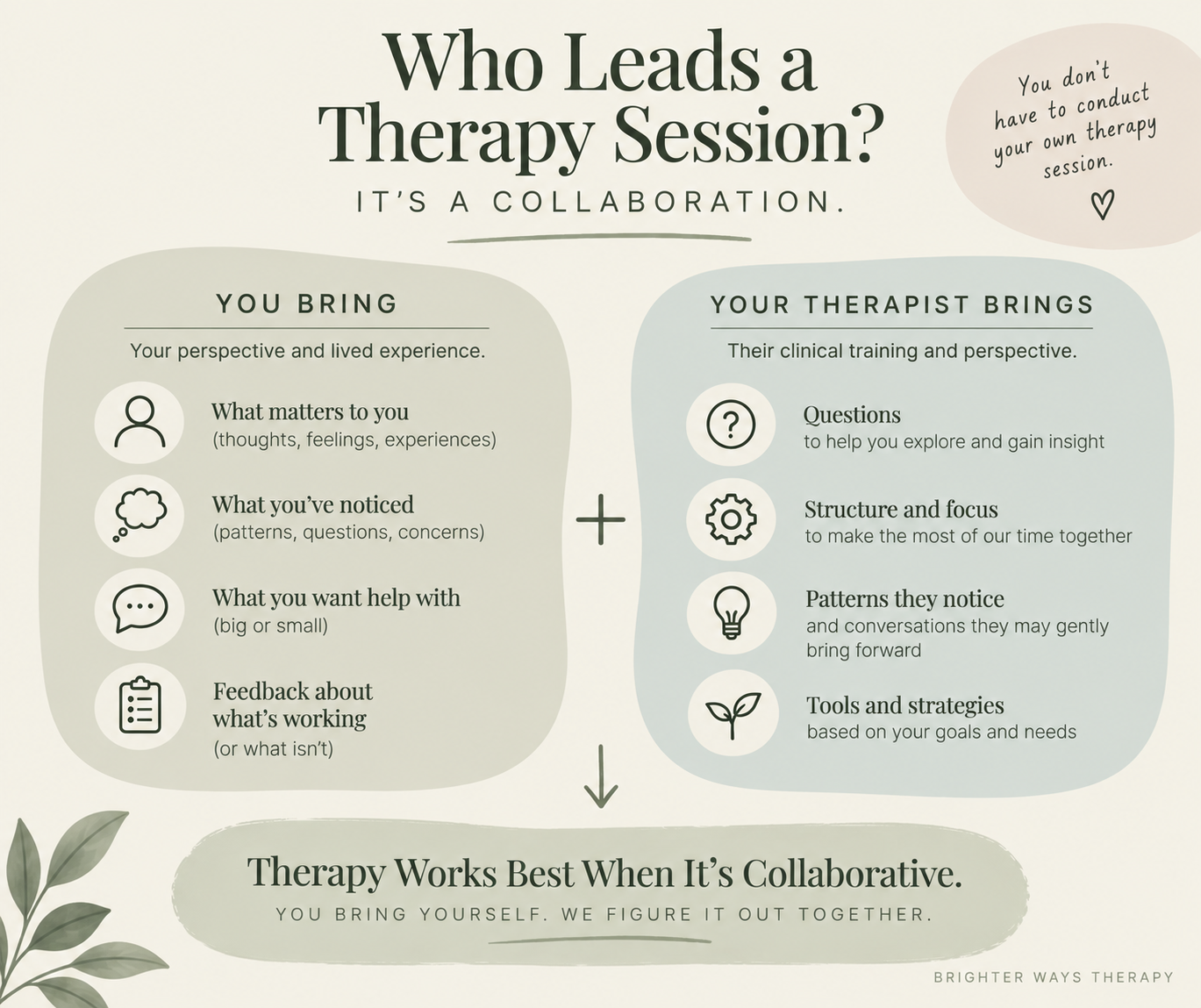
What if there’s an awkward silence?
There probably will be one eventually.
You don't need to fill every second.
Sometimes you're thinking.
Sometimes you're feeling something you don't quite have words for yet.
Sometimes your therapist may intentionally give you a little space instead of immediately asking another question.
And sometimes?
Neither of you knows what to say for a moment.
You're two humans in a room.
Silence doesn't automatically mean the session is going badly.
But if long silences make you uncomfortable or you don't understand what your therapist expects from you, you can bring that up too.
What if I keep leaving therapy feeling like we didn’t talk about what mattered?
That's a little different from occasionally not knowing what to talk about.
Maybe you repeatedly spend most of therapy describing your week but leave wishing you'd talked about something deeper.
Maybe you keep getting sidetracked.
Maybe there's a topic you keep approaching and then moving away from.
Or perhaps you don't feel like the sessions have enough direction.
That is worth bringing into the room.
You might say:
“I notice I keep talking about what happened during my week, but I don't feel like we're getting to the things I actually came to therapy for.”
Your therapist may not realize you're leaving sessions dissatisfied unless you tell them.
Ideally, you can talk together about what you'd like to be different
You don’t have to be good at therapy
There isn't a prize for arriving with the most insightful topic.
You don't need to know exactly why you feel the way you do.
You don't need to make every session profound.
And you don't need to perfectly organize everything happening in your life before you talk about it.
Sometimes you know exactly where you want to start.
Other times the most accurate thing you can say is:
“I have no idea what I want to talk about today.”
That is enough to begin.
At Brighter Ways Therapy, I work with adults across Ontario experiencing anxiety, overthinking, stress, relationship concerns, self-esteem concerns, and life transitions.
Sessions are offered online. If you are curious about whether therapy might be helpful for you, I offer a free 15 minute consultation to see whether we may be a good fit.
