
Why Do I Never Feel Good Enough?
Maybe you reach a goal you've been working toward and feel proud of yourself for a little while.
Then your mind moves on.
You start thinking about what you could have done better, what you still haven't accomplished, or what someone else seems to be doing that you aren't.
Maybe it's not achievement for you. Maybe you feel good about yourself when someone compliments you, wants to spend time with you, or tells you that you're doing well. But when that reassurance isn't there, the doubts start creeping back in.
Am I actually doing enough?
Why does everyone else seem further ahead?
What if I'm not as capable as people think I am?
Feeling like you're never good enough can be confusing, especially when there isn't one obvious thing wrong with your life. You may even recognize that you're doing well and still struggle to actually feel that way.

“Sometimes the question isn’t “Am I doing enough?” It’s “What have I learned I need to do before I’m allowed to feel good about myself?””
Why do I never feel good enough?
Feeling "not good enough" isn't always about what you're currently accomplishing.
Sometimes it has more to do with what you've learned to use as evidence that you're worthy.
Maybe being successful makes you feel good about yourself. Being needed by other people might do it. Or looking a certain way, being productive, receiving praise, being a good partner, or feeling like you're keeping up with the people around you.
None of those things are inherently bad. It feels good to accomplish something or hear that someone appreciates you.
The difficulty comes when your sense of worth depends heavily on those things continuing to go well.
A mistake can suddenly feel like evidence that you're not capable.
Someone else's success can make you question your own.
A period where you're less productive can leave you feeling lazy or behind.
Instead of simply having a disappointing experience, you start making conclusions about yourself because of it.
Why do my accomplishments never feel like enough?
You finally get the job, finish the degree, reach the fitness goal, receive the compliment, or accomplish something you spent months working toward.
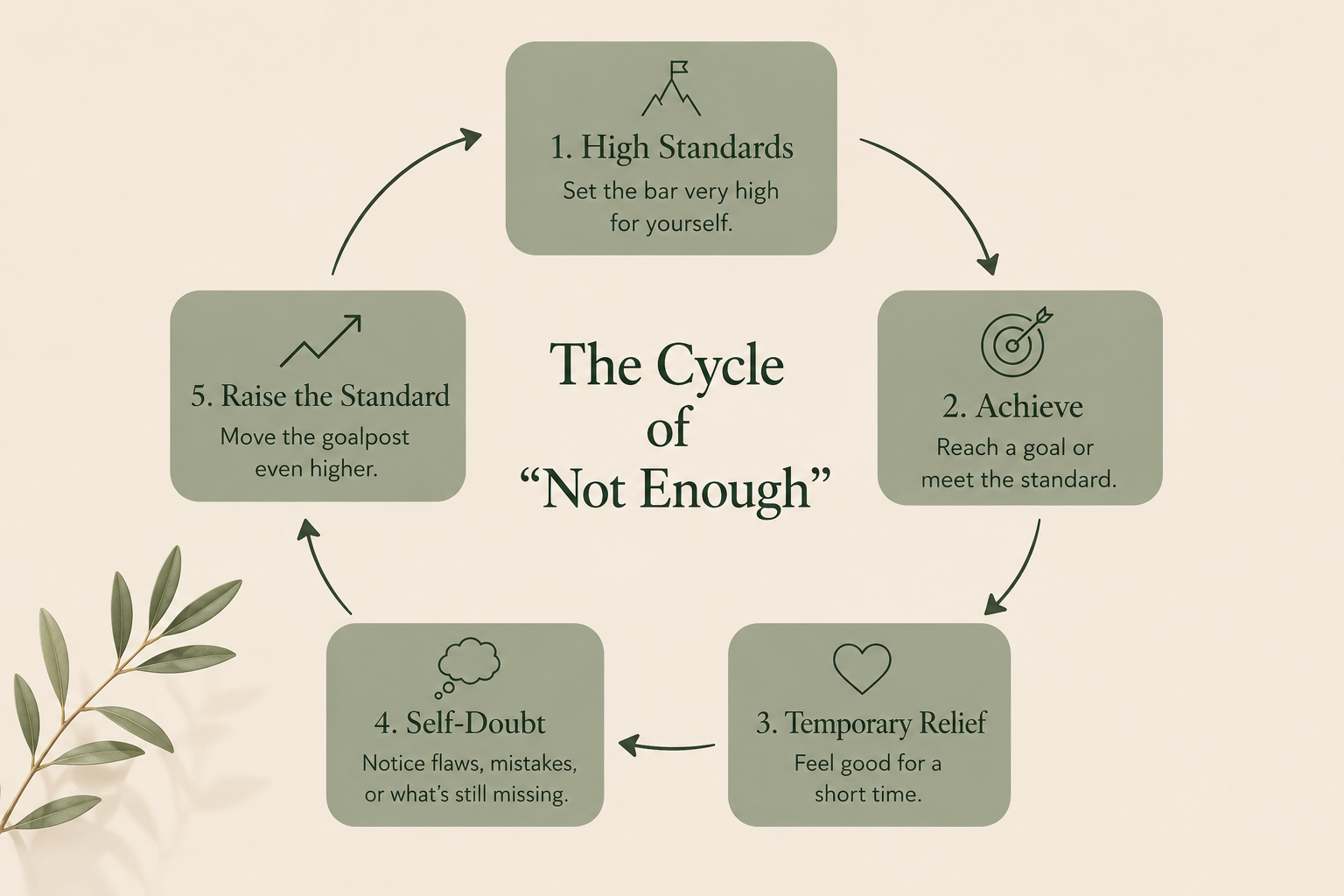
And then somehow the bar moves.
Okay, but now I should...
This can happen when achievement becomes closely tied to how you evaluate yourself. Research on perfectionism has described patterns in which people rely heavily on demanding personal standards when evaluating their worth.
You might genuinely feel good when you accomplish something. The problem is that the feeling doesn't have much time to settle before the next standard appears.
Maybe getting an A feels good until you notice someone got an A+.
Maybe getting promoted feels exciting until you start wondering why you weren't promoted sooner.
Maybe you finally become comfortable with one part of yourself and immediately find something else that needs improvement.
There is always another way to prove yourself.
And when the finish line keeps moving, it's very difficult to ever feel like you've arrived.
Why do I compare myself to everyone else?
Comparison gives you an easy measuring stick.
The problem is that you can almost always find someone who appears to be doing better in whatever category matters to you.
Someone earns more.
Someone seems more confident.
Someone's relationship looks happier.
Someone has the body you want.
Someone your age seems further ahead.
And you're usually comparing what you know about your own life with what you can see of theirs.
You know about your uncertainty, mistakes, bad days and insecurities. You don't necessarily know theirs.
Comparison can also become particularly powerful when you already feel unsure of yourself. Instead of simply noticing that someone has something you want, their success starts to feel like information about you.
They're doing better, so I must be doing badly.
But someone else being successful doesn't actually tell you whether you're doing enough with your own life.
Where does the feeling of not being good enough come from?
There isn't one explanation that applies to everyone.
For some people, growing up around high expectations or frequent criticism may have shaped how they learned to evaluate themselves.
For others, approval may have felt easier to access when they were achieving, helping, behaving a certain way, or meeting other people's expectations.
Experiences with rejection, bullying, comparison, difficult relationships, cultural or family expectations, and environments where mistakes carried a lot of weight can also influence the standards you develop for yourself.
And sometimes there isn't a clear moment you can trace it back to.
You may simply realize that somewhere along the way, you became very good at noticing where you fall short and much less comfortable letting yourself believe you've done enough.
Understanding where that pattern came from can be useful. But you don't have to identify one perfect explanation before you can begin responding to yourself differently.
How can I start feeling good enough?
You don't have to convince yourself that you're amazing at everything.
That would probably feel fake anyway.
A more useful place to start is noticing what you're using to measure your worth.
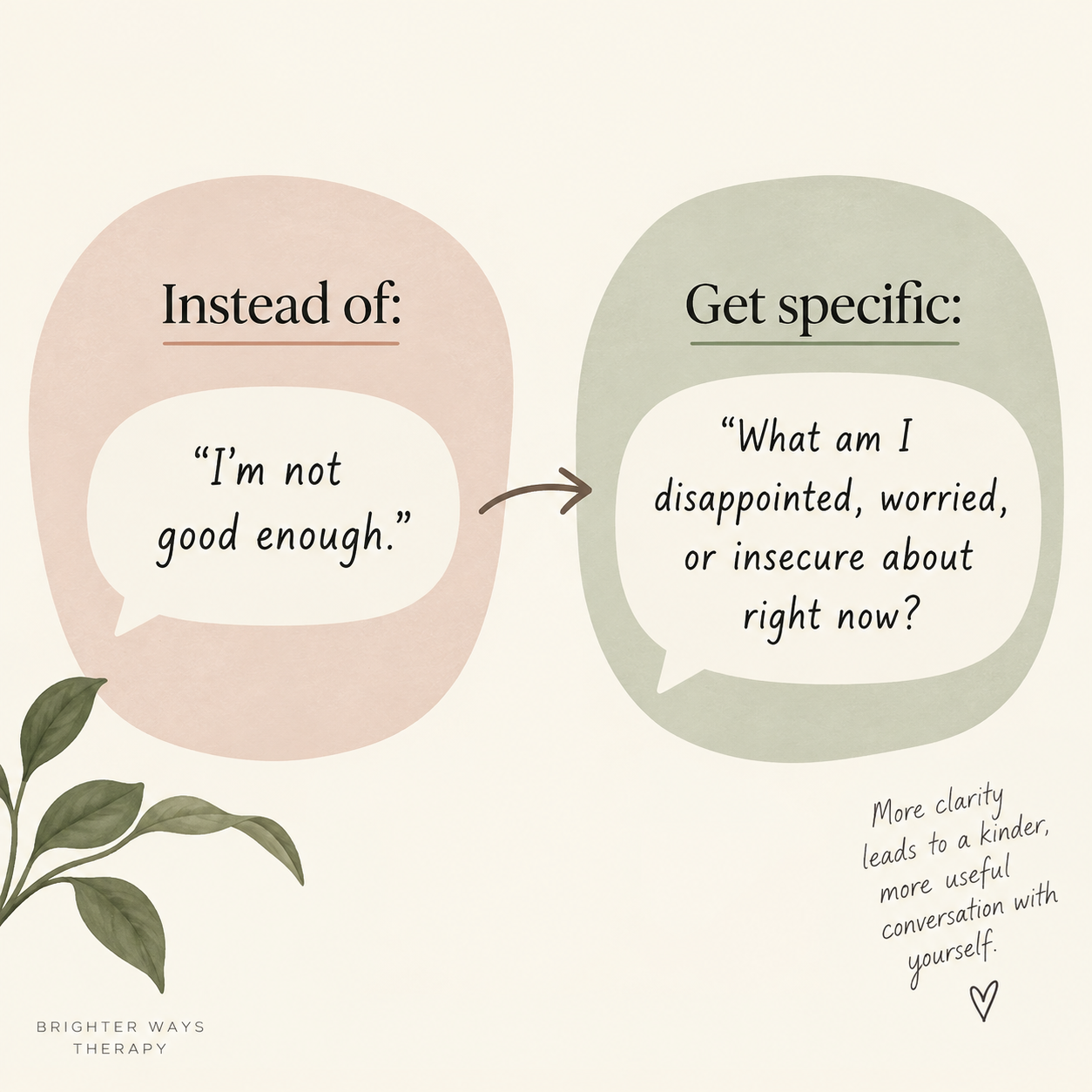
When you find yourself thinking I'm not good enough, try getting more specific.
Not good enough at what?
Maybe what you actually mean is:
I'm disappointed with how I handled that.
I wish I were further ahead in my career.
I want to feel more confident in my body.
I'm worried someone won't choose me.
Those feelings may still be uncomfortable, but they're much more workable than I'm not good enough.
One describes something you're struggling with.
The other turns that struggle into a conclusion about who you are.
You can also start noticing when the standard changes after you've met it.
If something mattered enough to work toward, see what happens when you actually accomplish it. Do you let yourself take it in? Or does your mind immediately produce the next requirement?
You can want to grow without making your ability to respect yourself dependent on constantly becoming better.
Can therapy help when I never feel good enough?
Therapy can give you space to understand what your sense of worth has become attached to and where some of those expectations may have come from.
You might explore the standards you hold yourself to, what happens emotionally when you don't meet them, how much other people's approval influences the way you see yourself, and whether you're applying rules to yourself that you wouldn't expect anyone else to meet.
The aim isn't to stop caring about achievement or improvement. It's to build a sense of self that doesn't disappear every time you make a mistake, fall behind, or don't receive the validation you were hoping for.
If you notice that feeling inadequate often turns into harsh self-criticism, you may also find Why Am I So Hard on Myself? Understanding Your Inner Critic helpful.
At Brighter Ways Therapy, I work with adults across Ontario experiencing self-esteem concerns, anxiety, overthinking, relationship concerns, stress, and life transitions.
Sessions are offered online. If you are curious about whether therapy might be helpful for you, I offer a free 15-minute consultation to see whether we may be a good fit.
