
Why Do I Need So Much Reassurance in My Relationship?
Maybe your partner seems a little quieter than usual and you immediately wonder if something is wrong.
You ask if they're okay. They tell you they are.
For a little while, you feel better.
Then another thought comes up.
But what if they're just saying that?
Maybe you ask again. Or you start paying closer attention to their texts, their tone of voice, how affectionate they are, or whether they seem different from yesterday.
If you've experienced this, you might wonder why reassurance never seems to be enough. Your partner can tell you they love you, that they're not upset, or that nothing has changed, and you may genuinely believe them in that moment. But the relief doesn't always last.
Wanting reassurance from someone you love is normal. Most of us want to know that we are loved, wanted, and secure in our relationships.
The problem isn't that you ever need reassurance. It can become difficult when reassurance becomes one of the main ways you cope with uncertainty in your relationship, especially when you find yourself needing it again and again to feel okay.

“Reassurance can answer the question you’re asking right now. The harder part is when your mind keeps finding a new question.”
What does reassurance seeking look like in a relationship?
Reassurance seeking isn't always as obvious as repeatedly asking, Do you still love me?
Sometimes it looks like asking your partner whether they're mad at you several times, even after they've said they're not.
Sometimes it's rereading a text because their response seemed shorter than usual.
You might ask whether they still find you attractive, whether they're happy in the relationship, or whether you did something wrong.
Other times, you may not ask anything directly. Instead, you watch.
Are they texting me as much today?
Why didn't they kiss me when they came home?
They usually use a heart in their goodnight text. Why didn't they tonight?
Were they more affectionate last week?
Any one of these things could mean something, or they could mean very little. But when you're already worried about the relationship, small changes can suddenly feel important.
You may find yourself looking for something that will tell you, with certainty, that everything between you is okay.
Why do I need reassurance from my partner so often?
Sometimes reassurance seeking starts with a very understandable goal: you want to feel safe in the relationship.
If you're worried that your partner is upset, losing interest, pulling away, or might eventually leave, getting reassurance can settle that fear.
Your experiences can also shape how easily uncertainty shows up in relationships. Past experiences of rejection or betrayal, inconsistent relationships, low self-esteem, or times when you didn't feel emotionally secure can affect what feels threatening now. Research on romantic relationships has also found an association between attachment anxiety and excessive reassurance seeking.
That doesn't mean that needing reassurance automatically means you have an anxious attachment style.
And sometimes there is something happening in the current relationship that is contributing to the anxiety.
That's important.
Not every uncomfortable feeling in a relationship is something you need to "work on" within yourself. If your partner is frequently inconsistent, dishonest, dismissive, or behaving in ways that make the relationship genuinely feel unstable, wanting reassurance may make sense in that context.
Instead of immediately asking yourself, Why am I so needy?, it can be more useful to get curious about what you're actually afraid of.
Are you afraid your partner is upset with you? That they're losing interest? That something has changed between you? Or that you might miss a sign that the relationship isn't okay?
Understanding the fear underneath the reassurance seeking can tell you much more than criticizing yourself for needing it.
Why does reassurance only make me feel better temporarily?
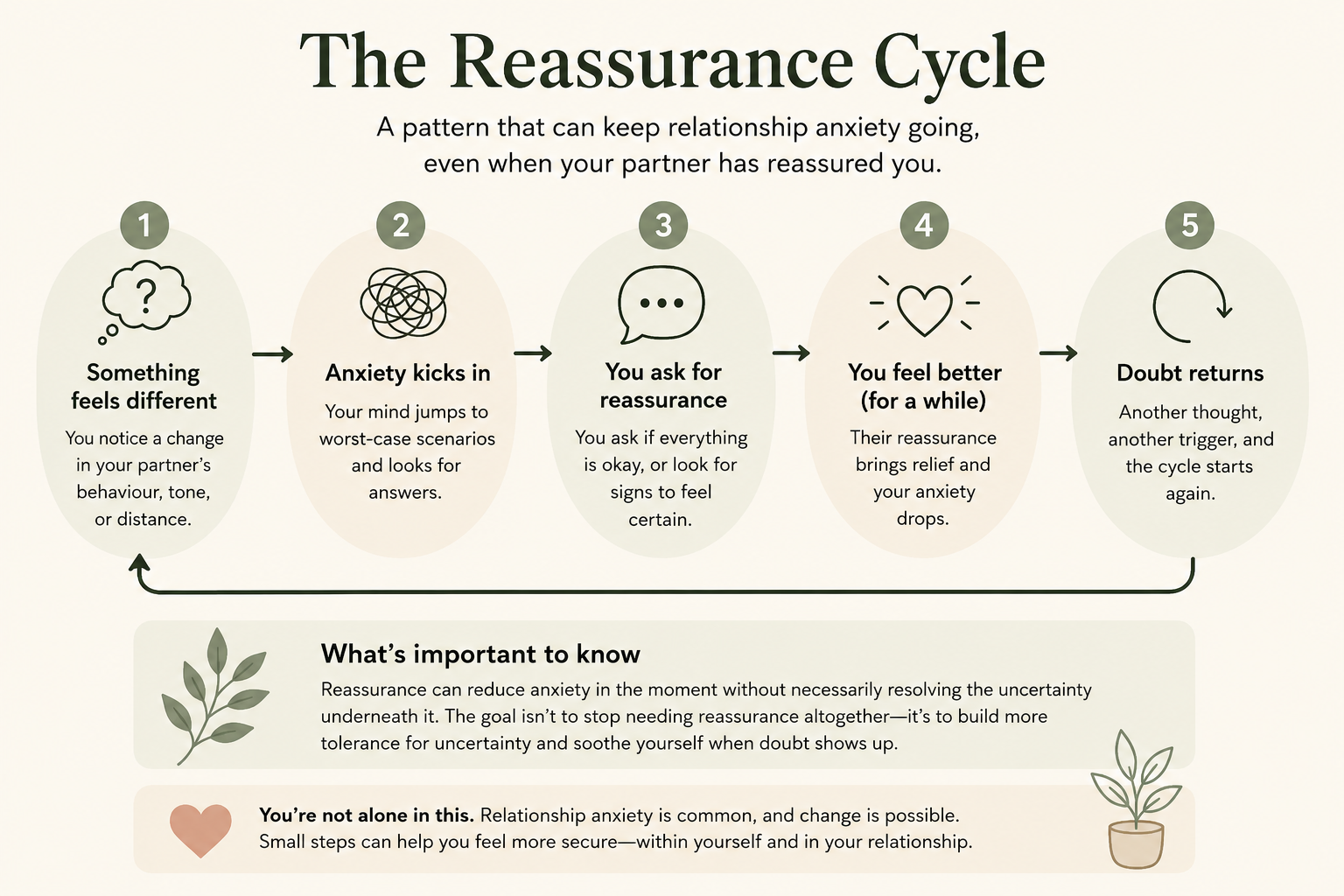
Imagine your partner takes longer than usual to respond to a message. You start wondering whether they're upset with you.
Eventually you ask.
Are we okay?
They tell you everything is fine, and your anxiety drops.
The next time something feels different, you might find yourself wanting that reassurance again. Maybe they're distracted at dinner or don't initiate affection one evening. The situation is different, but the urge is familiar: I need to know we're okay.
This is how reassurance can start to feel like a cycle. It helps settle the worry in the moment, but it doesn't necessarily make you feel more comfortable the next time uncertainty shows up.
This doesn't mean reassurance from a partner is bad. Feeling reassured and supported by someone you love is a normal part of a relationship. It becomes more difficult when you find yourself depending on reassurance every time something feels uncertain.
Why do small changes in my partner's behaviour make me anxious?
When you're already worried about a relationship, small changes can carry a lot of meaning.
A quiet evening feels different.
A change in affection catches your attention.
Your partner saying, "I'm just tired," might be completely true, but another part of you wonders whether there is something they're not telling you.
Previous experiences can matter here too. If you've been betrayed, rejected unexpectedly, or spent time in relationships where someone's behaviour really was unpredictable, it may be harder to brush off changes now.
But noticing a change and knowing what that change means are two different things.
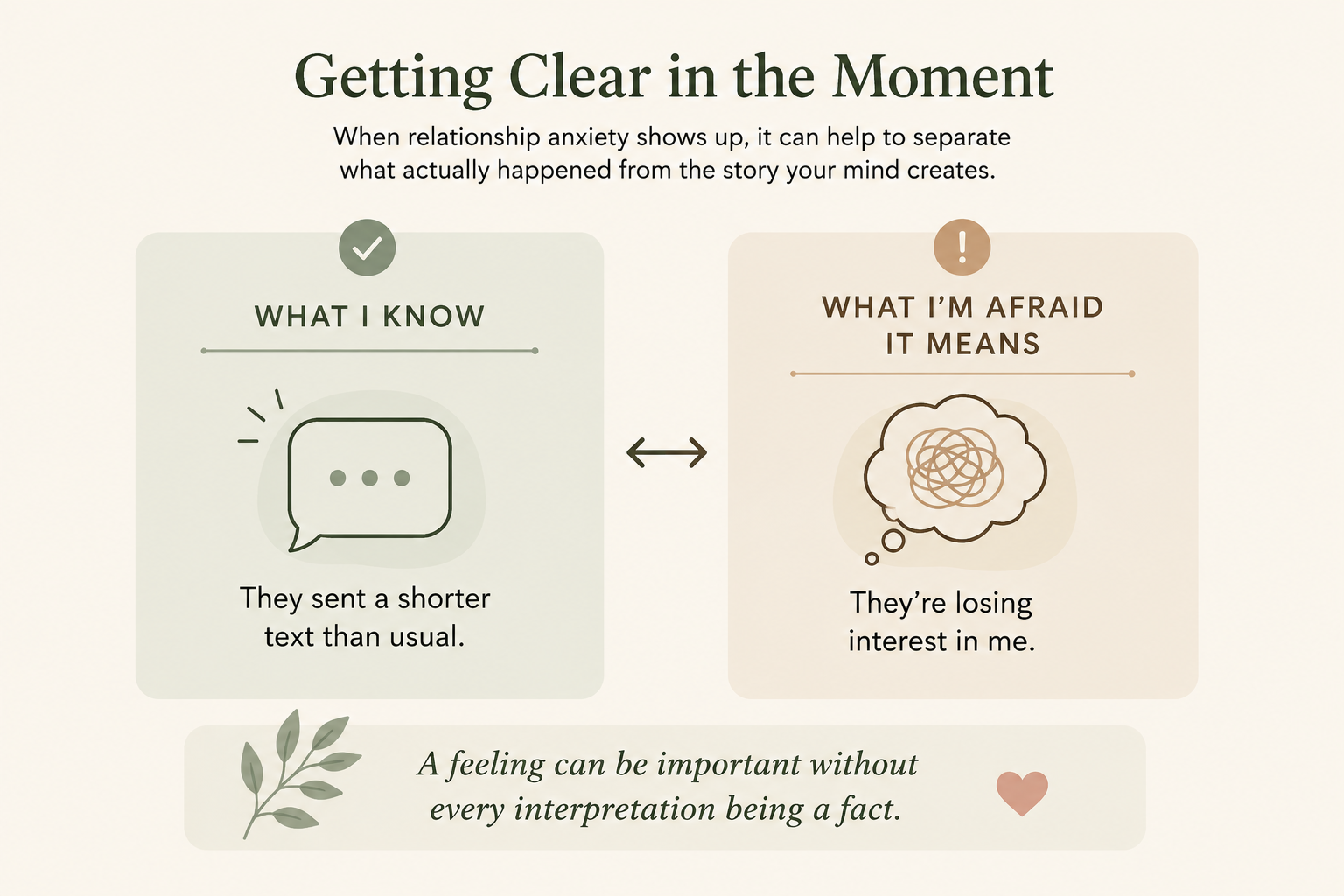
Your partner being quiet is something you can observe.
They're losing interest in me is an interpretation.
Sometimes that interpretation may turn out to be accurate. Sometimes it won't. The difficult part is not immediately knowing which one it is.
Is asking for reassurance unhealthy?
No.
You are allowed to want reassurance from your partner. You are allowed to ask whether something is wrong. You are allowed to want affection, communication, consistency, and emotional closeness.
Trying to become so independent that you never need anything from another person isn't the goal.
What can be helpful is noticing why you're asking.
Maybe something has genuinely been bothering you and you want to talk about it.
Or maybe anxiety has spiked and you're hoping your partner can make the feeling go away.
Those aren't necessarily the same conversation.
You don't need to stop turning to your partner for comfort. But if you notice that no answer feels reassuring for very long, it may be worth paying attention to what keeps bringing the question back.
How can I stop needing constant reassurance?
Start by noticing what happens just before you want reassurance.
Maybe your partner seems distracted. Maybe plans change unexpectedly. Maybe you notice less affection than usual.
Before immediately trying to figure out what it means, get specific about what you actually know.
What happened?
My partner has been quieter tonight.
What am I assuming?
They're upset with me.
What am I afraid this could mean?
Something is wrong between us.
This isn't about convincing yourself that your fear is irrational. It's about separating what you've observed from what you're afraid it means.
You can also experiment with giving yourself a little time before acting on the urge to check.
You might still decide you want to talk to your partner. If something has been bothering you consistently, having that conversation may be important.
But you don't necessarily have to resolve every moment of uncertainty as soon as it appears.
Over time, the goal is to have more than one way of responding when relationship anxiety shows up, rather than depending entirely on your partner to make the feeling disappear.
When can therapy help with relationship anxiety?
If you spend a lot of time wondering whether your relationship is okay, analyzing your partner's behaviour, asking for reassurance, or feeling anxious when you don't know exactly what your partner is thinking, therapy can give you a place to understand what's happening underneath those fears.
That might involve looking at experiences from previous relationships, your expectations of yourself and others, how you respond to uncertainty, or patterns within your current relationship.
It can also help you get clearer about something that is easy to lose sight of when you're anxious: whether you are reacting to uncertainty, responding to a genuine problem in the relationship, or dealing with a little of both.
If relationship worries also lead you to replay conversations or analyze situations repeatedly, you may find Why Do I Overthink Everything? Understanding Overthinking and Anxiety helpful as well.
At Brighter Ways Therapy, I work with individuals across Ontario experiencing anxiety, overthinking, relationship concerns, self-esteem concerns, stress, and life transitions.
Sessions are offered online. If you are curious about whether therapy might be helpful for you, I offer a free 15-minute consultation to see whether we may be a good fit.
