
Why Can’t I Relax Even When I Have Nothing to Do?
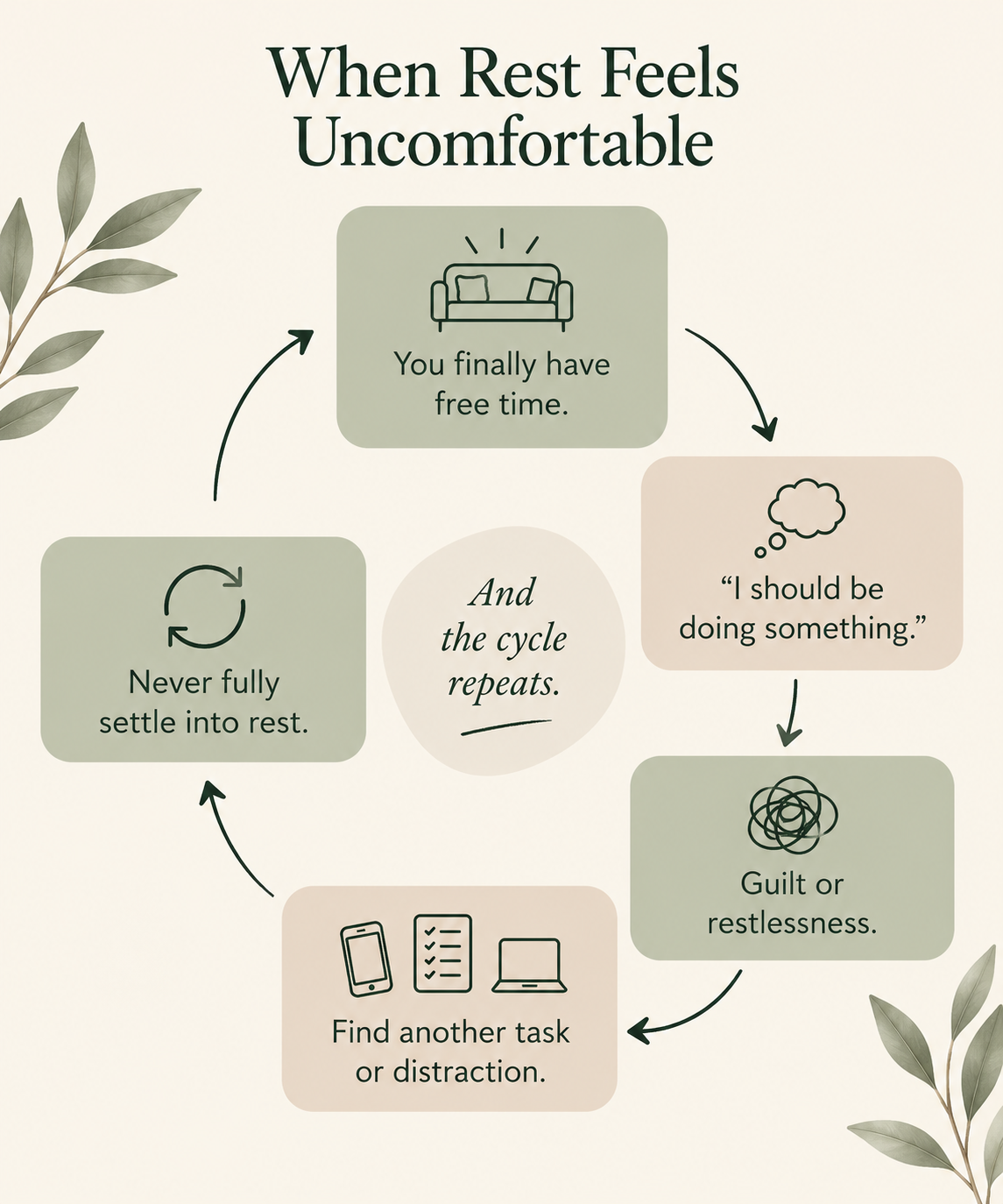
You finally have an evening with nothing planned.
There are no emails you need to answer. No errands you have to run. Nothing urgent needs your attention.
You should be able to relax.
Instead, you find yourself scrolling through your phone, thinking about what you could be getting done, or feeling strangely restless.
Maybe you sit down to watch a show but can't really focus on it. You remember something you should do tomorrow. Then something you forgot to do last week. Before long, you're mentally reorganizing your entire life from the couch.
Or maybe doing nothing simply makes you uncomfortable.
You feel lazy. Unproductive. Like you're wasting time.
If you struggle to relax even when you finally have the opportunity, it doesn't necessarily mean you're bad at resting. There may be something about slowing down that is harder for you than it seems.

Why can't I relax?
There isn't one reason people have difficulty relaxing.
Sometimes you've simply been busy for so long that slowing down feels unfamiliar.
If most of your day involves responding to things, solving problems, meeting deadlines, helping other people, or thinking about what needs to happen next, your attention is constantly being pulled toward the next task.
Then suddenly you're supposed to sit on the couch and switch all of that off.
It doesn't always happen immediately.
You may physically stop working while your mind keeps going.
Other times, the difficulty isn't busyness itself. It's what comes up when the busyness stops.
You might notice worries that were easier to ignore during the day. You may start thinking about something that's been bothering you or become more aware of tension you've been carrying.
Sometimes quiet simply gives your thoughts more room to be noticed.
“If you only let yourself rest once everything is finished, you may spend a very long time waiting. There is almost always something else you could be doing.”
Why do I feel guilty when I'm relaxing?
For some people, rest comes with an uncomfortable thought:
I should be doing something.
Maybe you look around and notice laundry that could be folded. You remember an email you could answer. You think about the workout you skipped or something productive you could be doing with your time.
There will almost always be something you could do.
So if you believe you need to finish everything before you're allowed to relax, rest keeps getting postponed.
Your relationship with productivity can play a role here too.
Maybe being productive makes you feel responsible, capable, or accomplished. Perhaps you've become used to measuring a good day by how much you got done.
Rest doesn't provide the same obvious evidence of accomplishment.
You can spend two hours getting things done and point to everything you completed. Spend two hours resting and there may be nothing to show for it.
That doesn't make the time pointless.
Why do I feel anxious when I finally slow down?
Have you ever been busy all day and felt relatively okay, only to lie down at night and suddenly start thinking about everything?
That doesn't necessarily mean relaxing caused the anxiety.
During a busy day, your attention has somewhere to go.
You're answering messages, driving somewhere, working, exercising, talking to people, figuring out dinner, or moving from one responsibility to another.
When those distractions disappear, thoughts and feelings that weren't getting much attention may become easier to notice.
That might be tomorrow's responsibilities.
It might be a conversation you haven't stopped thinking about.
Or you may simply notice that you feel tense without immediately knowing why.
This can make staying busy tempting. If slowing down means becoming more aware of uncomfortable thoughts or feelings, filling the space gives you something else to focus on.
But constantly keeping yourself occupied also means you rarely get the chance to learn what it's like to have quiet time without immediately escaping from it.
How can I learn to relax without feeling guilty?
You don't need to become perfectly calm every time you have free time.
In fact, trying very hard to relax can become another task to succeed at.
Instead, notice what gets in the way.
When you sit down and immediately think I should be doing something, what do you believe you should be doing?
Is it actually urgent?
Or is there simply something available to do?
Those are different things.
You can also pay attention to the rules you've developed around rest.
I can relax after I finish everything.
I shouldn't waste the day.
I haven't done enough to deserve a break.
Other people are doing more than me.
Once you notice the rule, you can decide whether you actually agree with it.
What if I genuinely have too much to do?
Sometimes difficulty relaxing isn't primarily about your mindset.
Sometimes you actually have too much on your plate.
If you're working long hours, caring for other people, dealing with financial pressure, managing family responsibilities, going through a stressful life change, or consistently trying to fit more into your day than your time allows, it makes sense that switching off may be difficult.
You can't always think your way into feeling relaxed while your life continues to demand more than you can reasonably give.
In that situation, it may be more useful to look at what you're carrying.
What actually needs to be done?
What can wait?
What have you taken responsibility for that doesn't necessarily have to be yours?
Where might your expectations of yourself be making an already demanding situation even harder?
Sometimes learning to rest involves changing your relationship with downtime. Sometimes it involves making your life a little less impossible to recover from.
Can therapy help if I can't relax?
If you rarely feel able to switch off, therapy can help you understand what tends to happen when you slow down.
Maybe your mind immediately jumps to everything you haven't done. Maybe rest brings up guilt. Maybe anxiety becomes louder when there aren't other things demanding your attention. Or perhaps you've been carrying so much for so long that you aren't sure what feeling rested even looks like anymore.
Therapy can give you space to look at those patterns and figure out what actually needs to change, rather than turning relaxation into one more thing you feel like you're failing at.
If your difficulty relaxing tends to involve repeatedly thinking through problems, decisions, or things that might happen, you may also find Why Do I Overthink Everything? Understanding Overthinking and Anxiety helpful.
At Brighter Ways Therapy, I work with individuals across Ontario experiencing anxiety, overthinking, stress, relationship concerns, self-esteem concerns, and life transitions.
Sessions are offered online. If you are curious about whether therapy might be helpful for you, I offer a free 15-minute consultation to see whether we may be a good fit.
